The idea
Explore whether past weather and sensor readings can help a fictional ranger team anticipate dry soil. Treat this as a modelling study using synthetic data, not advice for managing real land.
See this learning levelWhat you will build
- A prediction target and features that would actually be available at prediction time.
- A baseline and a trained regression model evaluated on the same held-out dates.
- An error report by conditions, plus an explanation of why unfamiliar inputs are unreliable.
How it fits together
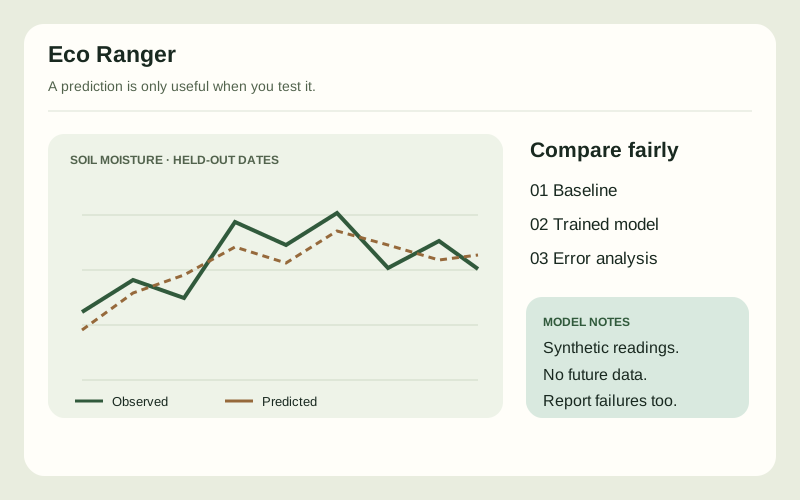
Use dated synthetic observations of rainfall, temperature and prior soil moisture. Split chronologically before fitting preprocessing or models. Compare next-day moisture predictions using mean absolute error and inspect errors by dry and wet periods.
Build milestones
Frame the prediction
Define next-day moisture as the target, its units and when each feature is known. Identify possible leakage.
Establish a baseline
Reserve the latest dates for testing. Predict tomorrow using today's moisture and record baseline errors.
Train and compare
Fit a simple regression model using training data only. Tune with validation data and evaluate once on the reserved test set.
Explain the limits
Plot predicted versus observed values, inspect the largest errors and write a model card describing synthetic-data limits.
How you will know it works
- Future readings never enter input features or preprocessing fitted on training data.
- Baseline and model scores use identical held-out rows and units.
- Missing values and out-of-range inputs have explicit handling; a poor result is reported honestly.
What you will finish with
A Python modelling notebook, dataset specification, comparison charts and a model card.
Take it further
Compare a tree-based model and test whether any improvement persists across different date windows.